
Who Actually Owns Your Sewer Line? A Manassas Homeowner’s Guide
Most people assume the sewer stops being theirs at the property line. In most of Virginia it doesn’t, and the difference can be the length of a street. Here’s how the responsibility line really works.
The part that shocks people
We get this call a few times a year. Sewage backing up into a basement in Manassas, homeowner already on the phone with the city, and the city says it isn’t theirs. The homeowner is certain there’s a mistake, because the problem is out under the street, and the street is obviously not their property.
Here’s the thing. In most Virginia localities the pipe is treated separately from the dirt above it. The utility owns the sewer main, the big line running down the middle of the street collecting from everybody. You own the lateral, your single pipe running from the house out to the point where it ties into that main. Not to your property line. To the main.
That commonly means you own pipe under your front yard, under the sidewalk, under the curb, and out under a lane of asphalt. You don’t own the land there and you can’t do anything to it without permits, but the pipe under it is generally still yours to fix. That’s the sentence that ruins people’s week.
Finding out for your address
General patterns set expectations. They don’t replace your actual address, and rules do vary by locality, so make the call. The direct route is the City of Manassas utilities department. Ask plainly where the city’s responsibility ends at your service address, and ask whether they have a service card or tap record showing where your lateral connects. Even an old record narrows the search considerably. Write down who you spoke with.
What won’t help you is your closing folder. Your deed describes land, not buried utilities. The plat may show an easement, which tells you where the city has the right to access something, but an easement is not the same thing as owning the pipe inside it. People read an easement line and conclude the city owns everything under it. That’s usually not how it works.
Your cleanout is the landmark
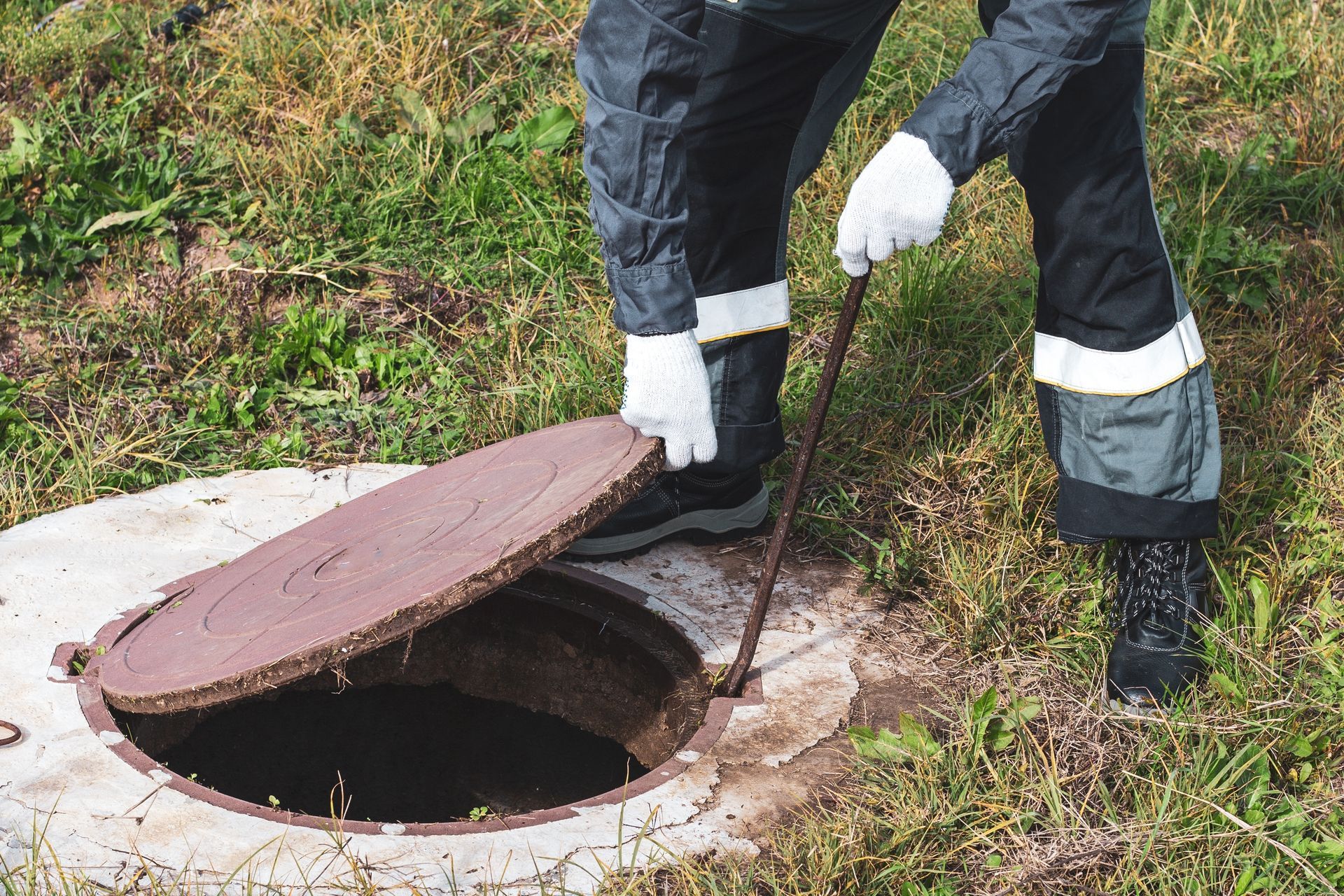
The cleanout is a capped pipe stub, typically three or four inches across, sitting somewhere between the house and the street. Sometimes it’s flush in the lawn under a round cap, sometimes it’s in a small box, sometimes it’s a floor drain style opening in the basement instead. On plenty of Manassas properties it’s buried under a few years of mulch and grass and the owner has never once seen it.
It matters for two reasons. First, it’s the access point. That’s where a camera goes in and where a jetter goes in, and having one that’s findable turns a difficult job into a routine one. Second, it’s a landmark. Cleanouts frequently sit near the property line, so knowing where yours is gives you and the city a shared point of reference when you’re sorting out which side of a problem you’re standing on. If you don’t know where yours is, solve that on a calm Tuesday rather than at midnight with water rising. We can locate it, and if the house never had one, adding one is a small job.
Mainline problem or lateral problem
The practical question during a backup is which pipe failed. A mainline issue usually shows itself across more than one house. If your neighbors on both sides are backing up the same night, that points to the main, and that’s the utility’s call. Report it right away.
A lateral problem is yours alone. One house affected, everything else on the block running fine. Roots in your joints, a belly in your run, a crack under your driveway. That’s a camera job, not a phone call to the city. There’s a middle case too, where the lateral fails right at the connection to the main. Those get argued about, because both parties can point at the other pipe. That’s exactly where having footage beats having an opinion.
Roots, clay joints, and the classic dispute
The most common dispute we see starts with a tree. Older Manassas neighborhoods have mature trees along the street, and a lot of the laterals under them are clay tile laid in short sections. Every few feet there’s a joint. Those joints were never watertight, and after decades of ground movement they’re less so.
Roots find that seepage and grow straight into the pipe, then spread into a mat that catches everything going past. Snake it and flow returns for a while, then it’s back, because the root system is still there and the joint is still open.
Now the homeowner looks up, sees a city street tree directly over the failure, and reasonably concludes the city caused it. It’s a fair argument that usually loses. Responsibility ordinarily follows the pipe, not the vegetation, on the reasoning that a sound lateral doesn’t admit roots in the first place. Raise it with the city anyway, especially with clear footage of the intrusion point, because it costs nothing to ask. Just don’t build your budget around winning it.
Ask your agent about a service line rider
A standard homeowners policy typically does not cover the buried sewer lateral. It may cover water damage inside the house from a backup, sometimes only with a separate endorsement, and still leave the pipe and the excavation entirely to you. Many carriers offer a service line rider that extends coverage to underground lines running to the house, sometimes including the digging and surface restoration. Terms and limits vary widely between companies.
We’re plumbers, not insurance agents, so we won’t tell you what to buy. We’ll tell you it’s a five minute question for your agent, and the people who ask it in advance have a much better week than the people who find out during a claim.
What a camera locate establishes before anyone digs
When ownership is genuinely in question, guessing is expensive. We run a camera through the cleanout down the length of the line, and the camera carries a transmitting sonde that we track from the surface. That gives us two facts nobody can argue with: what the defect is, and exactly where it sits, marked on the ground with a measured distance from the house.
That changes the conversation. Instead of “there’s a problem somewhere out front,” it’s a specific failure at a specific footage you can compare against wherever the city says its responsibility begins. If it lands on your side, you know precisely where to dig and how much you’re opening up. If it lands on theirs, you’re calling with a documented position instead of a complaint. It also tells you the pipe material and the condition of the rest of the run, which matters when you’re deciding between a spot repair and the whole lateral while the ground is open.
Townhomes and the HOA wrinkle
Townhome communities around Manassas add a layer. Units sit close together, and laterals often share a trench or tie into a common branch before reaching the main. When one unit backs up, three neighbors and a management company get involved fast. The governing documents decide it, and they are not uniform. Some communities have every unit owning its own lateral all the way out even though the pipes run side by side. Others have the association maintaining a shared branch.
Read yours before there’s a problem. When there is one, a camera run settles the question everyone fights about first, which is whose line is actually failing. We’ve been on plenty of these where the unit with the backup wasn’t the unit with the broken pipe.
Straight answers from people who’ve dug these up
Between my father and me there’s 45 years of plumbing in this. He ran the plumbing department at the largest plumbing company in the country, so we’ve been through the ownership argument more times than we can count, from both sides.
What we do is get you facts. We locate your cleanout, run the camera, mark the defect on the ground, and tell you plainly what we found and what it takes to fix. Then you make your calls with something solid in hand. We’re licensed, insured, and we run this work all over Prince William County. If your line is backing up, or you just want to know what you own before it matters, call us at 540-671-5417.
Want to know more? See our Sewer Inspections service, browse recent work, or ask us for a free quote. You can also reach us at 540-671-5417. We pick up, we show up, and we tell you straight what is wrong.
Common questions
Where does my responsibility for the sewer line usually end?
In most Virginia localities the homeowner owns the lateral, meaning the pipe running from the house all the way to the connection at the public main. That often includes the stretch under your sidewalk and under the street. The utility owns the main itself. Rules vary by locality, so confirm your address with the City of Manassas utilities department before you plan any repair.
The city’s street tree caused the roots. Doesn’t that make it their problem?
Usually not. Responsibility commonly follows the pipe, not the tree. Roots enter a lateral because the joints leak, and the lateral is generally the homeowner’s pipe no matter what species is growing over it. It is still worth raising with the city, and camera footage showing exactly where the intrusion sits helps you make the case. Just don’t count on it.
How do I find out who owns what at my specific address?
Call the City of Manassas utilities department and ask directly where their responsibility ends at your service address. Ask if they have a service card or tap record for your connection. Your deed and title paperwork almost never spell this out, so don’t waste time hunting through the closing folder.
Where is my cleanout and why does it matter?
The cleanout is a capped pipe stub, usually a few inches across, sitting in the yard between the house and the street, or sometimes in a basement floor. It is the access point for a camera or a jetter. It often sits near the property line, which makes it a useful landmark when you’re sorting out which side of a problem you’re on. If you can’t find yours, we can locate it.
Does homeowners insurance cover a collapsed sewer lateral?
A standard policy typically does not cover the buried line itself. Many carriers sell a separate service line rider that can help with the pipe and the digging. Coverage and limits differ a lot between companies, so ask your own agent what your policy actually includes and what a rider would add before you need it.
We’re in a townhome. Who owns a shared lateral?
That depends on your HOA documents and the recorded plat, and it is worth reading before there’s a backup. Some townhome communities have each unit running its own lateral through a shared trench. Others have units tying into a common branch that the association maintains. A camera run establishes which unit’s line is actually failing, which is the fact everybody argues about first.
Need a plumber in Manassas, VA?
Family owned, 45 years of combined experience, free quotes and 24/7 emergency service across Prince William County and Northern Virginia.
540-671-5417