
Tank or Tankless for a Stephens City Family
Both are good machines. Which one belongs in your house depends on your morning routine, what fuel already reaches the property, and where the vent can legally go.
Shopping For A New Heater?
Call 540-671-5417 and we will walk your house with you before anybody writes a number down. The quote is free and we will tell you when the cheaper option is the better one.
Families replacing a heater usually arrive with the decision half made by something they read, and the reading rarely accounts for the specific house. A tankless unit that transforms one home is a poor fit two streets over for reasons that have nothing to do with the appliance. So rather than argue the general case, here is what we actually weigh at a Stephens City address, in the order we weigh it.
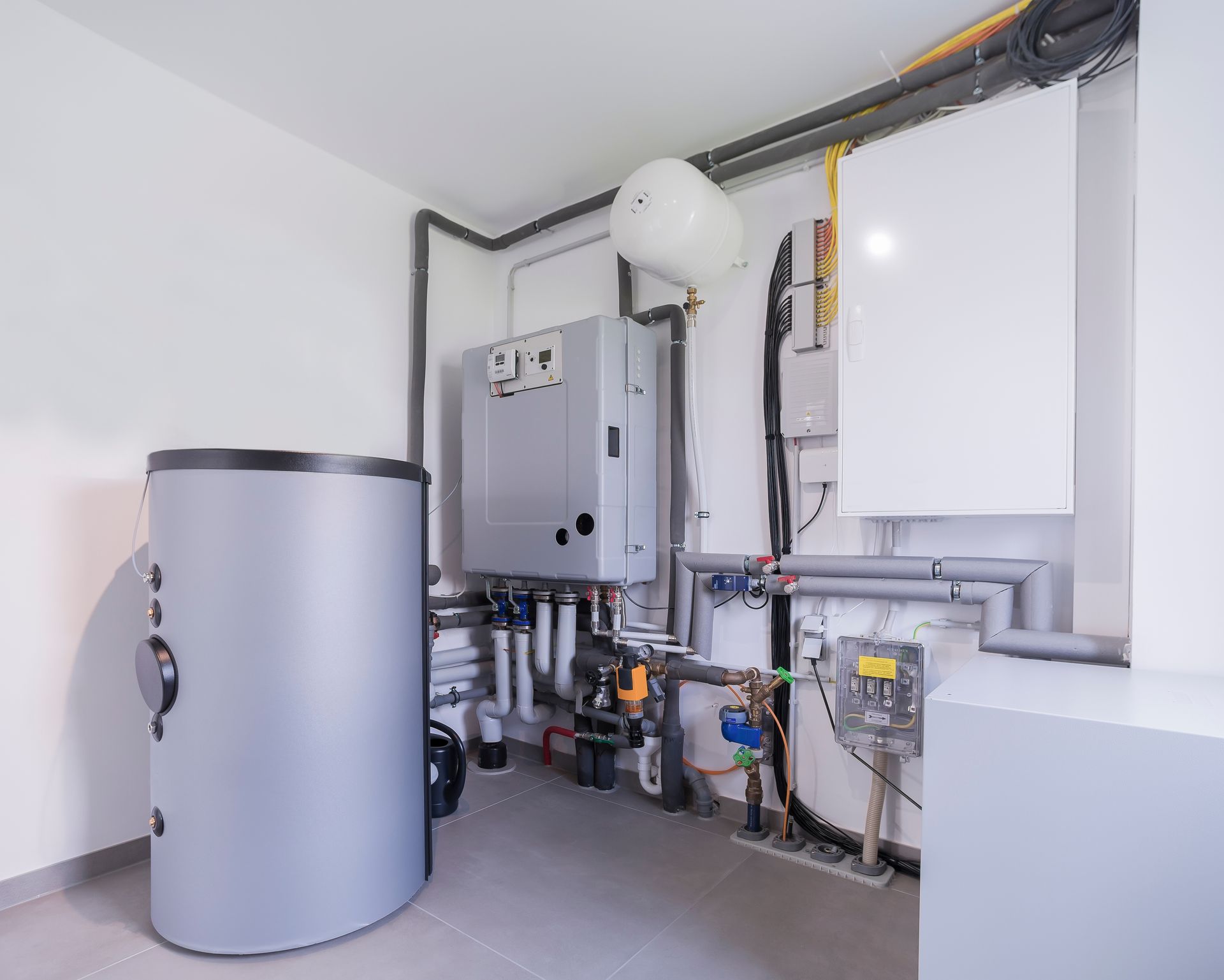
Count The Mornings, Not The Gallons
Sizing goes wrong when it starts from a number on the old unit. The question that matters is how your household actually uses hot water in its heaviest hour. Two adults who shower twelve hours apart barely stress anything. Five people leaving between six thirty and seven fifteen, with the dishwasher going and somebody starting laundry, put a load on the system that no amount of stored volume politely absorbs if the volume is wrong.
A tank answers that with reserve. It holds a quantity of already-hot water and hands it over as fast as you can draw it, then needs time to make more. Sized correctly for your peak hour, nobody ever notices it exists. Sized short, the last person out gets what is left. A tankless answers the same question with rate instead. It never runs out because it is heating continuously as water passes through it, but it can only deliver so many gallons a minute at a given temperature rise, and running two showers and a dishwasher at once is exactly where an undersized unit disappoints. Reserve or rate, one of them has to fit the mornings you actually have.
Fuel And Electrical Were Decided Years Ago
Whoever built the house made a chunk of this decision already, and pretending otherwise is how a cheerful quote turns into an unpleasant afternoon. If gas serves the property, a same-size tank generally drops right into place. A tankless unit is a different proposition, because it fires at a much higher rate when it runs, and the existing line and meter frequently cannot feed that. The remedy is a larger run back toward the meter, which is real work and belongs in the price you are given at the start.
All-electric houses have their own arithmetic. A standard electric tank or a heat pump unit are the sensible options, and both work well. Electric tankless is a harder sell in a family home because delivering meaningful flow at a February temperature rise draws current that most residential panels are not built to give without a service upgrade. Switching fuels entirely is possible only where gas already reaches the street. Where it does not, bringing service in costs more than the appliance does, and we would rather say that plainly on the first visit than discover it together later.
Venting Is Where The Plan Meets The Building
Combustion equipment has to exhaust safely, and that requirement quietly rules out more options than sizing ever does. An atmospheric gas heater relies on a working flue and enough air in the room to burn properly. Some of the equipment closets in the older housing stock were laid out for appliances that no longer meet current clearance rules, so reusing the existing arrangement is not automatically available.
Where the flue cannot serve, a direct vent or power vent model exhausts through a sidewall instead, which solves the problem cleanly as long as somebody planned the route. Condensing units, tank or tankless, add a second requirement: they produce acidic condensate that has to reach a legal drain, sometimes through a neutralizer depending on what it discharges into. None of this is exotic and all of it is routine work. What it cannot be is an afterthought, because the route and the materials are part of what the job costs, and a quote that skipped them was never a real quote.
What Each One Asks Of You Afterward
The maintenance difference is worth understanding before you choose, because it is where owners are most often surprised. A tank forgives neglect for a good while. It wants draining once a year and its anode rod checked periodically, and if you forget for a couple of years it keeps working while quietly shortening its own life. The consequences are gradual.
A tankless unit is less forgiving on water like ours. There is no reservoir, so the mineral load passes directly across a compact heat exchanger, and scale accumulating in those narrow passages costs you flow rate and efficiency noticeably faster than a tank loses capacity. Descaling on schedule keeps it performing the way it did the week it went in. Skipped for years, the unit gets blamed for a problem that was maintenance all along, which is a shame given how long a properly serviced one lasts. If you know yourself to be someone who never thinks about the utility room, that is a genuine argument for a tank, and we will say so.
How The Swap Day Actually Runs
A tank-for-tank replacement is a same-day job when we have the right unit on the truck, and on an emergency call that is usually the shape of it. Old unit drained and out, new one set, connections made, pressure and expansion checked, and hauling the dead one away is included every time. Nobody should be wrestling a rusted tank into a pickup on their own.
A conversion to tankless is a longer day and sometimes more than one, because gas sizing, mounting, venting, and condensate all have to be built rather than reconnected. That is not a reason to avoid it. It is a reason to plan it rather than decide it in a crisis with water on the floor. Frederick County permits this work, which we pull and meet the inspector for, and that second set of eyes on the venting and the relief discharge is worth having in your file. The full detail is on our Stephens City water heater installation page, past jobs are in the gallery, and the contact page gets you on the calendar.
Frequently Asked Questions
Will a tankless unit really never run out of hot water?
It will not run out, but it does have a ceiling on how much it can deliver per minute. Size it for your simultaneous use in winter and you never meet that ceiling. Size it for summer numbers and a busy February morning finds it.
Is a tank the wrong choice in a newer house?
Not at all. A properly sized tank in a house with a purpose-built utility space is a fine, forgiving machine that asks very little of you. We install plenty of them for families who prefer simple, and we would not talk anyone out of that.
Do I need an expansion tank either way?
If a pressure reducing valve or backflow preventer sits on your incoming line, yes. That closes the system, so heated water has nowhere to expand and pushes back at the heater instead. We measure your static pressure and charge the expansion tank to match it.
Weighing a new heater for a Stephens City house? Call 540-671-5417 or reach us through the contact page, and we will size it against your actual household.