
Ajax Plumbing LLC / Bentonville, VA · Video Camera Pipe Inspection
Bentonville Video Pipe Inspection Look at the drain before you buy or dig
A home inspection usually stops at the fixtures. The pipe carrying everything out of the house, under the floor and out across the yard, goes unseen. We push a camera down that line, stand at the monitor with you while it travels, and tell you in plain words what is down there.
540-671-5417Ask about a camera runThe houses we worry about most in Bentonville are the river houses and the farmhouses that have been added onto more than once. Their drains are often cast iron or old clay, laid long before anyone living there now was born, and buried where nobody has looked since. A camera is the one way to see that pipe without digging it up to find out.
The footage tells us where to dig, so the yard gets one hole instead of three.
What the camera turns up under older houses
Most of what we find on a Bentonville camera run falls into one of these five. Each looks different on the monitor, and each calls for a different answer.
Cast iron gone at the bottom
Cast iron rusts from the inside, and the bottom of the pipe, where water runs every single day, wears through first. On the screen the top of the pipe can look fine while the floor of it is flaking, scaled, or simply missing, with soil showing underneath. A run in that shape can still drain for a while. It will not drain forever.
Roots through the joints
Old clay and cast iron runs have a joint every few feet, and each one is a doorway for a root looking for water. On camera it shows up as hair-fine threads at first, then a mass hanging across the pipe like a curtain. Cutting it out helps, but the joint it came through decides whether it grows back.
A belly in the run
When part of a line settles, it makes a low spot that holds water. The camera dips under the surface, the picture goes murky, and then it climbs out the far side. Solids settle in that dip and build up, which is why a house with a belly drains slowly and backs up again after every clearing.
Offsets and breaks
A joint that has shifted leaves a lip that catches paper. A crack lets soil and roots in. Sometimes a section has been crushed outright, by a vehicle crossing the yard or by an addition built over a line nobody knew was there. Each one needs a different repair, so we name exactly which one we are looking at.
Somebody’s old patch
Plenty of older drains carry a section someone already replaced, a piece of plastic spliced into cast iron with rubber couplings. Some of those hold up well for decades. Others sag at the coupling or leave a gap. The camera shows us which kind you have before it becomes the next problem.
Before you sign on a river house
A home inspector runs the faucets, flushes the toilets, and checks the water heater. What nobody sees is the building drain, the pipe that leaves the house under the floor and runs out to the tank. On an older property that pipe is often the most expensive thing that could be wrong, and it is completely hidden. The time to run a camera is before buying, after backups that keep coming back, and every few years once the pipes are old.
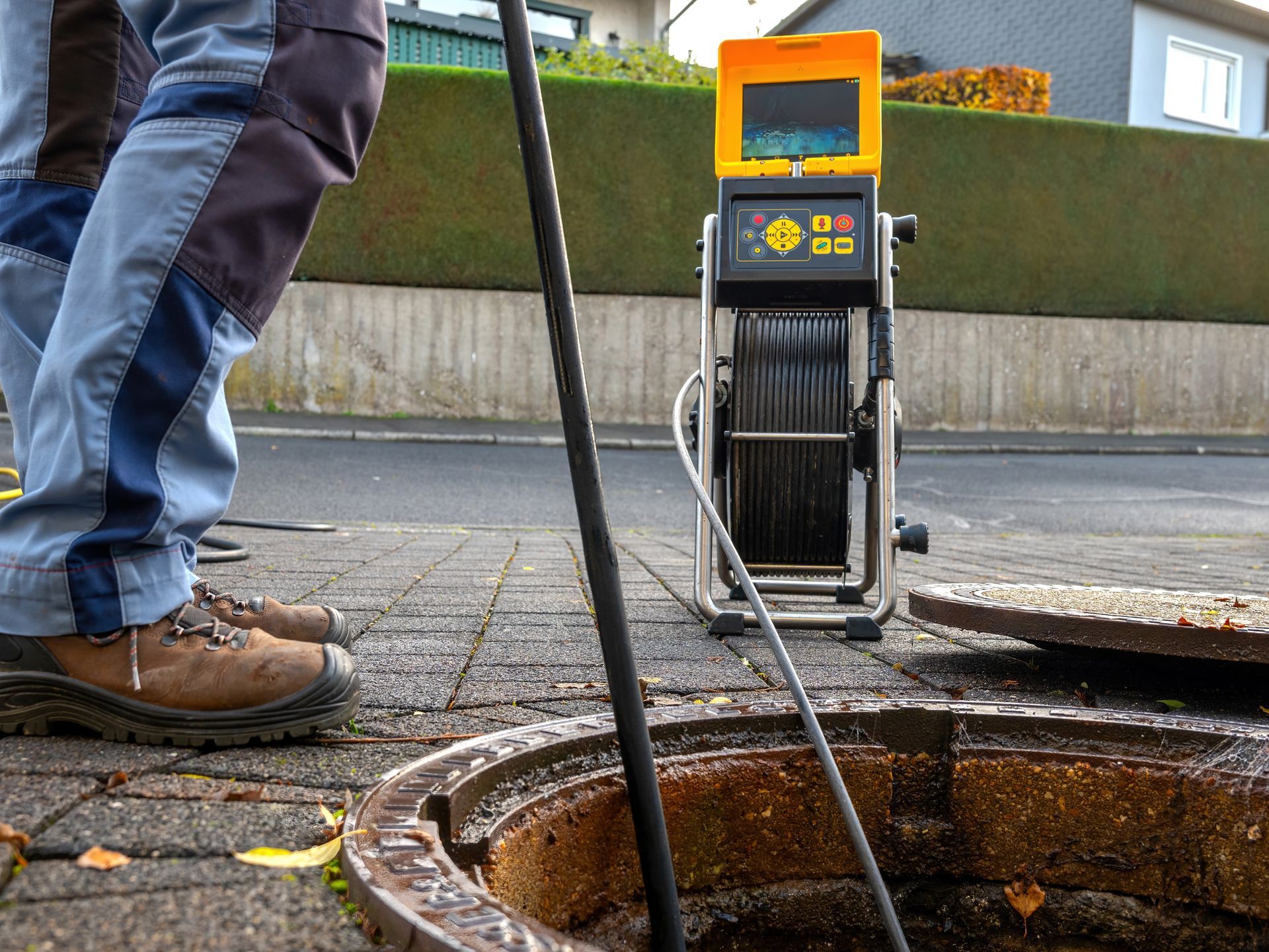
Getting in is usually simple. If the house has a cleanout we open it. If it does not, we can often go in through a toilet flange. The camera feeds out on a stiff cable, and a counter on the reel tells us how many feet out the head is. When it reaches something worth fixing, a locator above ground picks up the signal from the head and reads its depth. We mark that spot on the grass. Any repair then starts as one hole in the right place, never a guess.
The reel counter and the locator put the problem on the grass before anybody digs.
You watch the monitor with us. We stop at anything worth a second look and explain what it is. When the run is done, you get a straight read: the line is sound, the line needs watching, or the line needs work, and roughly where.
Looking at a house now and want to know what is involved? Call 540-671-5417 and tell us about the property. Our full video camera pipe inspection page covers this work across the valley.
The run out to the septic tank
A lot of Bentonville sits on private wells and septic, so the building drain does not end at a county main. It runs from the house to the tank, and on an older lot nobody may know exactly what that run is made of or where it goes. We follow it with the camera all the way to the tank inlet and tell you what we saw along the way: a belly, a break, roots at a joint, or a clean pipe.
What a camera will not do is pump the tank, measure how full it is, or tell you whether the drainfield is still taking water. That is septic company work, and we say so plainly. If the line checks out clean and the house still backs up, the trouble is probably at the tank or past it, and we point you that way instead of selling a line repair you do not need.
Want to see the kind of work we hand back? It is in the gallery. To book a camera run, use the contact page.
We bring the camera down to Bentonville and the rest of Warren County from our shop in Front Royal.
When the footage points to other work
Sometimes the camera is the end of the visit. Other times it tells us what comes next, inside the house as much as under the yard.
A bath that drains slowly because the addition was plumbed wrong from day one gets fixed at the source with bathroom plumbing remodeling. If we find seized shutoffs while we are under the sink setting up the camera, swapping them goes with the faucet installation. For a house still going up, the drain to the tank gets laid and tested as part of new construction plumbing, and when the heat in an old farmhouse finally gives out, we handle the boiler installation too.
We drive down Route 340 from Front Royal along the South Fork of the Shenandoah, fifteen to twenty minutes depending on the river traffic, with Rileyville just down the road and Howellsville Road part of the same loop. The Bentonville page lists the rest of our work in town, and the Warren County hub covers the county.
Questions people ask before the camera goes in
The house drained fine at the showing. Is a camera still worth it?
Usually, on an older property. A drain can run clear during a showing while the bottom of a cast iron pipe is rotting through or roots are working into a joint. Those problems show up months later, after you own the house. A camera run before closing tells you what you are actually buying.
Can you inspect the line out to my septic tank?
Yes. We follow the building drain from the house to the tank inlet and report any belly, break, or root intrusion along the way. The camera does not pump the tank or rate its condition. If the line is clean and backups continue, we point you toward a septic company.
What if the house has no cleanout?
We can often go in through a toilet flange instead, pulling the toilet and resetting it on a new wax ring when we finish. If neither works for the run you are worried about, we talk through whether adding a cleanout makes sense, since it makes every future clearing and inspection easier.
Can you tell me exactly where to dig?
Close to it. The reel counter gives the distance out to the problem, and a locator above ground picks up the camera head and reads how deep it sits. We mark the spot on the ground, so a repair starts with one hole in the right place instead of a long trench.
Do I get to see what you see?
You do. You stand at the monitor with us while the camera travels, and we stop at anything worth a closer look and explain it. At the end you hear a plain verdict on whether the line is sound, needs watching, or needs work, and where that work would be.
How often should an older drain get a camera run?
Before you buy, after backups that keep returning, and every few years once the pipe is old cast iron or clay. A line that keeps needing to be cleared is telling you something, and the camera shows what. Catching a failing section early beats finding it during a backup.
Want eyes on that line first?
Tell us what the water is doing, or which house you are thinking of buying, and one of us calls you back. The quote is free.
Drain backing up right now? Call 540-671-5417, 24/7.