
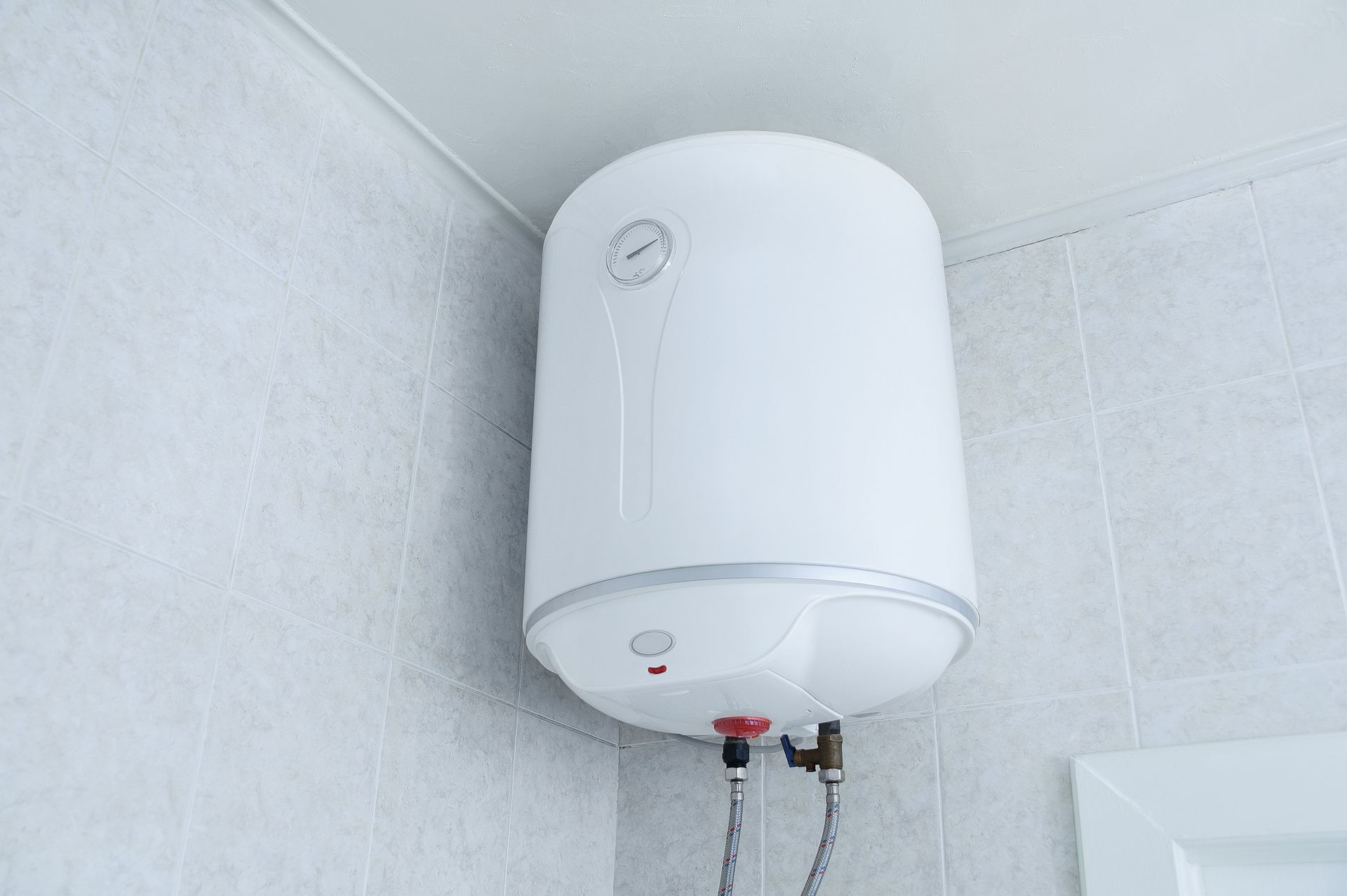
The Townhouse Water Heater Closet: Why Replacement Is Never Just a Swap in Manassas
Thirty inches of closet, often upstairs, and a tank that has to come out the same way it went in. Here’s what that job really involves.
The closet is the job
Manassas has a lot of townhomes built in the 1980s, and the builders put the water heater in an interior closet. Around 30 inches wide, bifold door, drywall on three sides. Plenty of them are on the second floor, tucked next to a bedroom or across from the laundry.
Homeowners call and ask what a water heater costs. Fair question. But in these houses the tank is the cheap part. The closet decides the job. How wide it is, what floor it’s on, what the stairs look like, and what code wants now that nobody wanted in 1985.
We’re not trying to run the price up. We’re telling you what we’re going to find so you hear it from us first instead of standing in the hallway at hour three wondering what happened.
Your new tank is fatter than your old one
This surprises people every time. Efficiency rules changed, and manufacturers hit them by wrapping more insulation around the tank. Same water inside, thicker heater outside. A 50 gallon unit built today is wider and usually taller than the 50 gallon unit it’s replacing.
In a garage nobody notices. In a 30 inch closet, two inches is the difference between it fitting and it not fitting. We’ve pulled doors and trim off closets to get a tank seated, and we’ve had houses where the honest answer was that the standard model was never going in there.
So we measure first. Closet width, closet depth, door opening, ceiling height, and the clearance above the tank for the flue and the water lines. Then we order. Measuring after the truck is loaded is how a one day job turns into two.
What code catches up on when you replace
Your old heater was legal the day it went in. It got grandfathered every year since. The day we pull it out, the replacement follows current rules, and in a townhouse closet that usually means a few additions.
A drain pan under the tank, with a drain line that actually goes somewhere, not just a pan sitting there catching water until it overflows. An expansion tank if the house has a pressure reducing valve or a backflow preventer, which most of these do, because a closed system has nowhere to put the pressure when water heats and expands. Proper strapping so the unit can’t walk or tip. And the temperature and pressure relief valve discharge routed correctly, down and terminating where a person won’t get scalded standing there.
None of it is exotic. All of it takes parts, fittings, and time that the old install never paid for. That’s why the number for a townhouse closet swap doesn’t match the number your neighbor with a basement got.
Upstairs failures are three floor problems
A water heater in a basement fails and you get a wet floor and a bad morning. A water heater in a second floor closet fails and the water goes down. Through the ceiling below, down the stairwell, into the lower level, and into everything stored there.
We’ve seen the aftermath in these neighborhoods more than once. That’s the whole reason we get particular about the pan, the drain line, and where the shutoff sits. If the valve is buried behind the tank where nobody can reach it in a panic, we move it.
Know where your main shutoff is before you need it. Walk down and put your hand on it once. Thirty seconds now saves a floor later.
Getting the tank up the stairs
People forget this part until they watch it. Townhouse stairwells are narrow, they turn, and the landing ceiling is low. A full size tank has to make that turn twice, once going out full of sediment and once coming in.
We drain the old unit before it moves so we’re not carrying an extra few hundred pounds of water through your hallway. We walk the path first and set down protection on the treads. When the turn genuinely won’t take a standard tank, that’s when a lowboy or a slim diameter model earns its keep. Same capacity, different shape, fits where the regular one won’t.
When tankless is the right answer in a closet, and when it isn’t
Tankless comes up on almost every one of these calls, and it’s a real option here. It hangs on the wall, it gives you the closet floor back, and there’s no stored water sitting over your living room waiting to fail. In a tight upstairs closet those are genuine advantages.
The catch is venting and gas. Tankless needs a vent path to an outside wall, and an interior townhouse closet is often surrounded by other rooms with a long run to daylight. It also burns more gas at once than your tank ever did, so the existing line may be too small and need upsizing back toward the meter.
If the outside wall is close and the gas line works out, we’ll tell you tankless is a good move. If both need reworking, a correctly sized tank in a proper pan is the smarter spend, and we’ll say that too. We install both and we don’t have a favorite.
What the visit actually looks like
We start with measurements and photos of the closet and the path in. We check the gas line, the venting, the shutoff, and the water pressure at a fixture, because high pressure is what kills these tanks early. Then you get a number that covers the pan, the expansion tank, the fittings, and the haul away, not just the heater.
On install day we protect the floors, drain and pull the old unit, set the pan and drain, seat the new tank, make up the water and gas, run the relief discharge, strap it, fire it, and test the whole thing before we pack up. We take the old heater with us. Then we show you the shutoff and the pan so you know what you’re looking at.
Father and son, 45 years between us, and my father ran the plumbing department at America’s largest plumbing company. We’re licensed, insured, backflow certified, and certified for most major heater brands. The quote is free.
Your fifteen minute check once a year
Open the closet and look in the pan. Standing water or rust stains mean something is weeping. Run your hand around the fittings on top and along the connections for damp. Find the date on the manufacturer’s label and do the math, because past ten years you should be planning instead of reacting. If it’s a tank with an anode rod you’ve never touched, that rod is likely gone, and once it is the tank starts eating itself.
Last thing, listen. A rumble or popping when the burner runs is sediment cooking on the bottom. That’s a flush, or a warning, depending on how old the unit is. Any of it, call us.
Questions about your own setup? Learn more about our Water Heaters, see recent work, or request a free quote. Or call us straight at 540-671-5417. We pick up, we show up, and we tell you straight what is wrong.
Common questions
Why won’t the same size water heater fit my Manassas townhouse closet?
Insulation standards changed, so today’s tanks carry a thicker jacket around the same water. A 50 gallon heater from the 1980s is skinnier and shorter than a 50 gallon heater built now. Same gallons, fatter tank. In a 30 inch closet that extra couple of inches is the whole job, which is why we measure the closet before we order anything.
Do I have to add a drain pan and expansion tank when I replace it?
If your closet is over living space, yes, you need a pan with a drain line going somewhere useful. Expansion tanks are required where the house has a backflow preventer or pressure reducing valve, and most Manassas townhomes do. Your old heater was installed under older rules and got grandfathered. Replacement is when everything catches up.
What happens if an upstairs water heater lets go?
Water finds the stairwell and takes out three floors on the way down. Ceilings, drywall, flooring, and whatever is stored in the lower level. That is why we care so much about the pan, the drain line, and the shutoff being reachable. A basement failure is a mess. An upstairs failure is a claim.
Can you even get a new tank up my townhouse stairs?
Usually, but it takes planning. Townhouse stairwells are narrow with tight turns and a low ceiling at the landing. We measure the path before the truck gets loaded, and we drain and haul the old unit out before the new one comes in. When the turn won’t take a standard tank, a lowboy or slim model solves it.
Is tankless worth it in a closet like this?
Sometimes. It frees the floor and takes the flood risk down. But it needs a real venting path to an outside wall and a gas line big enough to feed it, and interior townhouse closets often have neither. If the venting run is short and the gas works out, it’s a strong choice. If both need reworking, a properly sized tank is the smarter money.
How do I check mine between visits?
Fifteen minutes once a year. Look in the pan for standing water or rust stains, feel the fittings on top for damp, note how old the unit is off the label, and listen for rumbling when it fires. Any of those means call us. We’re licensed and insured, quotes are free, and we run 24 hour emergency service at 540-671-5417.
Need a plumber in Manassas, VA?
Family owned, 45 years of combined experience, free quotes and 24/7 emergency service across Manassas, Prince William County, and Northern Virginia.
540-671-5417